
Table of Contents
ToggleThe cannabis extraction industry is at a crossroads. As consumer demand shifts toward terpene-rich, full-spectrum products-and as regulatory frameworks tighten across North America and Europe-processors are being forced to reevaluate the methods they’ve relied on for years. The three dominant technologies, cryogenic ethanol, hydrocarbon, and supercritical CO₂, each come with well-documented trade-offs that limit product quality, operational efficiency, or both.
Aerosol extraction using R134a (1,1,1,2-Tetrafluoroethane) represents a fundamentally different approach. Rather than brute-force solvent saturation, it controls molecular interactions through fine aerosol delivery at low pressure and ambient temperature-preserving the volatile compounds that define strain identity while producing an extract that requires no post-processing.
PURE5™ Extraction, based in Phoenix, Arizona, has spent over 25 years developing and manufacturing botanical extraction systems. Their proprietary approach-called Pure Botanical Extraction (PBX™)-uses R134a aerosol technology to achieve what conventional methods cannot: a true strain-specific extract with full terpene and flavonoid preservation, zero post-processing, and industrial-scale repeatability.
This article provides a comprehensive look at how aerosol extraction works, why it outperforms conventional methods for terpene and flavonoid preservation, and what the PURE5™ 50-liter system delivers in a real production environment.
Watch the full system walkthrough
The Problem with Conventional Cannabis Extraction
Cryogenic Ethanol Extraction
Ethanol extraction is one of the most scalable methods available, making it a popular choice for high-volume operations. The process involves soaking cannabis biomass in chilled or cryogenic ethanol to dissolve cannabinoids and other compounds. However, ethanol is a polar solvent that indiscriminately dissolves a wide range of substances, including chlorophyll, plant waxes, and water-soluble compounds that are undesirable in the final product.
The real cost of ethanol extraction is terpene loss. Prolonged heat during evaporation degrades volatile terpenes, and because many terpenes share similar boiling points with ethanol, they are stripped away during solvent recovery. The result is an extract requiring extensive post-processing-winterization to remove waxes, filtration to remove chlorophyll, and often distillation to concentrate cannabinoids-each step further diminishing the terpene and flavonoid profile that defines a strain’s therapeutic and sensory character.
Hydrocarbon Extraction (BHO/PHO)
Butane and propane-based extraction can produce exceptional terpene retention, particularly with fresh-frozen material processed as live resin. However, the use of flammable, explosive solvents introduces significant safety and regulatory constraints. Operations must be conducted in C1D1 classified environments-expensive, purpose-built rooms designed to contain potential explosions.
Beyond safety, hydrocarbon systems face residual solvent concerns. Ensuring that butane or propane levels fall below regulatory limits (typically under 500 ppm) requires careful purging, adding time, energy, and complexity. Scaling is also constrained by volume limitations imposed by safety regulations on flammable solvent storage.
Supercritical CO₂ Extraction
CO₂ extraction is widely regarded as “clean” because the solvent leaves no residue. However, it operates at pressures exceeding 1,071 psi and temperatures above 88°F to reach the supercritical state. These conditions create a fundamental tension: supercritical parameters efficiently extract cannabinoids but degrade volatile monoterpenes. Subcritical parameters preserve terpenes better but take two to four times longer with lower yields.
CO₂ systems also carry substantial capital costs and require specialized operator training. Achieving consistent full-spectrum profiles batch after batch remains an ongoing challenge, not a set-and-forget operation.

How Aerosol Extraction Works
Aerosol extraction takes a fundamentally different approach to solvent-biomass interaction. Instead of soaking plant material in liquid solvent or forcing pressurized gas through packed beds, the system delivers R134a as a fine aerosol mist. This massively increases the surface area of solvent contact while dramatically reducing the volume of solvent needed and the mechanical stress on the plant material.
R134a (1,1,1,2-Tetrafluoroethane) is a non-flammable, non-toxic, non-corrosive fluorocarbon used for decades in pharmaceutical drug delivery, food processing, and refrigeration. It is a non-polar solvent with a low boiling point of −26.3°C, meaning it evaporates completely from the extract at room temperature-leaving zero residual solvent without any purging or vacuum processing.
The extraction takes place in a closed-loop system at low pressures (approximately 7 bar / ~100 psi) and ambient temperatures (20–25°C). Under these gentle conditions, the R134a aerosol selectively dissolves the oil-soluble compounds in the trichome heads-cannabinoids, terpenes, and flavonoids-while leaving behind chlorophyll, most waxes, and contaminants such as mold or certain pesticides.
Because extraction occurs at room temperature, there is no thermal degradation of heat-sensitive monoterpenes or decarboxylation of acidic cannabinoids (THCA, CBDA). The extract preserves the plant’s native chemical profile with remarkable fidelity.
Four Key Advantages of Aerosol Extraction
1. Terpene Preservation
Terpenes are volatile unsaturated hydrocarbons-primarily monoterpenoids (C10) and sesquiterpenoids (C15)-with multiple double bonds that make them extremely sensitive to heat, pressure, and oxidation. Common cannabis terpenes have boiling points ranging from 156°C to 198°C, but they begin degrading at much lower temperatures under prolonged exposure.
Aerosol extraction operates well below these thresholds. The combination of low pressure, moderate temperature, and ultra-short contact times means the solvent captures terpenes without altering their chemical structure. Independent laboratory analysis of PURE5™ extracts has confirmed terpene retention statistically indistinguishable from the terpene load of the starting biomass-a result unattainable with thermal or high-pressure processes at equivalent cannabinoid potency.
2. Molecular Selectivity
R134a’s non-polar nature gives it a natural affinity for oil-soluble compounds while ignoring water-soluble ones. The extraction targets acidic cannabinoids, terpenes, and flavonoids without pulling chlorophyll, excessive waxes, or water-soluble contaminants. A typical PURE5™ extract reads approximately 85% cannabinoids and 15% terpenes on COA, with less than 2% waxes-eliminating the need for winterization, distillation, or additional filtration.

3. Safety and Regulatory Compliance
R134a is non-flammable, non-explosive, and non-toxic, eliminating the need for C1D1 classified rooms, blast-proof construction, or specialized fire suppression. The system operates at approximately 7 bar-a fraction of the 60–80+ bar required for supercritical CO₂-with no cryogenic components. This makes it suitable for pharmaceutical and industrial environments where regulatory compliance is non-negotiable.
Third-party lab testing consistently confirms zero residual solvent in the finished extract-removing a compliance concern that plagues both hydrocarbon and ethanol processors.
4. Industrial Scalability and Repeatability
The PURE5™ system is engineered for production environments where batch-to-batch consistency matters. Every parameter-pressure, temperature, flow rate, and cycle time-is controlled, logged, and reproducible through an automated PLC interface. Closed-loop solvent recovery exceeds 99%, keeping operating costs low and environmental impact minimal. This is the difference between craft extraction and industrial manufacturing.
Inside the PURE5™ 50-Liter Extraction System
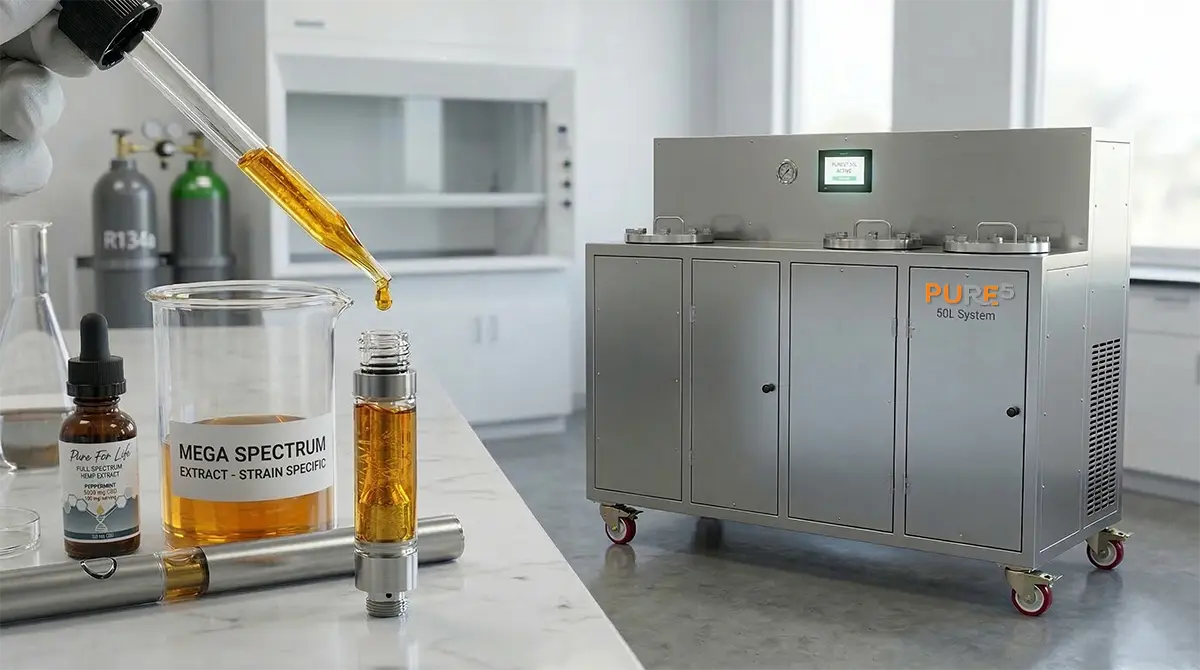
The 50-liter system is designed for commercial operators who need consistent, high-quality output at production scale. The “50 liters” refers to total extraction volume: two 25-liter vessels, each holding two cartridges of approximately 5 lbs, for a total capacity of roughly 10 lbs of biomass per cycle.
System Architecture
- Dual 25L extraction vessels with removable cartridge-based loading for fast biomass changeover
- Dedicated recovery vessel where enriched solvent releases the extract and R134a is recaptured
- Closed-loop solvent recovery with >99% recovery efficiency
- Fully automated PLC-controlled interface with touchscreen display and real-time process monitoring
- Up to 10 lbs/hour throughput with continuous batch cycling
Operation
Operating the system is remarkably straightforward. The operator loads biomass into removable cartridges, inserts them into the extraction vessels, and closes the system. The only two inputs required are process time and temperature-the machine calculates and manages everything else automatically.
The touchscreen provides real-time visual feedback: green indicates extraction mode, yellow indicates solvent recovery. Adjusting temperature and run time allows the operator to dial in lighter or thicker oil consistency and control the terpene-to-cannabinoid ratio. Training time to full proficiency is typically just a few hours.
Understanding Mega Spectrum Oil
The cannabis industry uses several terms to categorize extract types: full spectrum, broad spectrum, and live resin. PURE5™ introduces a new category ‘Mega Spectrum’ to describe an extract that preserves the complete profile of all three major compound families at their natural ratios.
The Three Compound Families
Cannabinoids (~85% of COA)
Science has identified over 75 cannabinoids in cannabis, though standard panels measure approximately 20. Aerosol extraction captures the full spectrum present in the flower-including minor cannabinoids like CBG, CBN, CBC, and THCV often lost in higher-temperature processes. Because extraction occurs at ambient temperature, acidic forms (THCA, CBDA, CBGA) are preserved in their native state.
Terpenes (~15% of COA)
The terpene fraction includes monoterpenes (limonene, myrcene, pinene, linalool), sesquiterpenes (beta-caryophyllene, humulene), and diterpenes-all preserved intact in their natural ratios. This complete terpene package defines the strain’s aroma, flavor, and contributes to the therapeutic entourage effect.
Research increasingly supports the entourage effect. A 2024 peer-reviewed clinical study conducted by researchers at Johns Hopkins University School of Medicine and the University of Colorado found that the terpene D-limonene significantly mitigated THC-induced anxiety when co-administered-providing some of the first clinical evidence that terpene-cannabinoid interactions produce measurably different therapeutic outcomes compared to isolated cannabinoids.
Flavonoids
Flavonoids are the least discussed but potentially most significant compounds in cannabis. More than 20 flavonoids have been identified in Cannabis sativa, including several-known as cannflavins-that are unique to the cannabis plant. Cannflavin A and B have demonstrated anti-inflammatory potency up to 30 times greater than aspirin in preclinical studies, working through inhibition of prostaglandin E2 production and 5-lipoxygenase activity.
Additional cannabis flavonoids-including quercetin, kaempferol, apigenin, and luteolin-exhibit antioxidant, neuroprotective, and potential anti-cancer properties, while contributing directly to taste and aroma. Because flavonoids are heat-sensitive, conventional high-temperature methods destroy or significantly degrade them. Aerosol extraction’s ambient-temperature process preserves the full complement.

Zero Post-Processing Required
Mega Spectrum oil from the PURE5™ system is ready to formulate immediately. No winterization (wax content below 2%). No distillation (cannabinoid-to-terpene ratio already optimized). No filtration (chlorophyll not extracted). No residual solvent purging (R134a off-gases completely at room temperature).
The extract goes directly into vape cartridges, gummies, tinctures, topical oils, water-soluble formulations, and pharmaceutical products. Bioavailability is among the highest available because the extract is a true chemical replica of the original strain.
Many compare this output to rosin, which also preserves terpenes through a solventless mechanical process. However, rosin applies heat and pressure that introduce plant lipids and impurities. Aerosol extraction achieves comparable or superior terpene preservation with pharmaceutical-grade purity. As stated in the video: you’re not going to see this anywhere else in the field.
| Factor | Ethanol | Hydrocarbon | CO₂ | Aerosol (R134a) |
|---|---|---|---|---|
| Terpene Preservation | Low | High (fresh-frozen) | Variable | Highest |
| Selectivity | Low (polar) | Moderate | Tunable but complex | High (non-polar) |
| Safety | Flammable | C1D1 required | High pressure | Non-flammable, low psi |
| Post-Processing | Winterize + distill | Purge + winterize | Winterize typical | None required |
| Residual Solvent | Moderate risk | High risk | None | None |
| Capital Cost | Moderate | Moderate | High (capital intensive) | Moderate |
| Operator Training | Moderate | Extensive | Extensive | Minimal (hours) |
| Scalability | High volume | Limited by safety | Limited by cost | Industrial scale |
Who Is the 50L System Designed For?
The PURE5™ 50-liter aerosol extraction system is built for serious operations that prioritize consistency, quality, and throughput at very low operational costs:
- Licensed cannabis processors scaling from craft to industrial production
- Pharmaceutical cannabis manufacturers requiring GMP-compatible processes
- Multi-state operators (MSOs) seeking standardized extraction across facilities
- Hemp extraction facilities producing terpene-rich CBD products for consumer markets
- Any operator needing repeatable, clean, compliant output without extensive post-processing infrastructure
Frequently Asked Questions About Aerosol Extraction
R134a (1,1,1,2-Tetrafluoroethane) is classified by the FDA as Generally Recognized As Safe (GRAS) for use in food and pharmaceutical applications. It has been used as a propellant in metered-dose inhalers for decades. The European Union has also approved it as an extraction solvent under EC Directive 2009/32. In the PURE5™ system, R134a evaporates completely at room temperature, and third-party lab testing consistently confirms zero detectable residual solvent in the finished extract – a compliance advantage that ethanol and hydrocarbon processors struggle to match.
Commercial supercritical CO2 systems typically range from $200,000 to over $450,000, plus $50,000-$150,000 for C1D2 room buildout, extensive operator training, and high energy costs from maintaining pressures above 1,071 psi. The PURE5™ R134a system operates at a fraction of that pressure (~100 psi), requires no specialized room classification, minimal training (hours, not weeks), and eliminates the need for post-processing equipment like winterization and distillation rigs – which can add another $100,000+ to a CO2 or ethanol operation's total investment. When you factor in total cost of ownership, PURE5™ delivers a significantly faster path to ROI.
Yes. The PURE5™ PBX™ process works identically on both cannabis and hemp biomass. Because R134a is a non-polar solvent operating at ambient temperature, it selectively extracts cannabinoids, terpenes, and flavonoids from any Cannabis sativa variety regardless of THC or CBD dominance. This versatility gives PURE5™ operators a strategic edge – a single system can serve both markets without retooling, recalibration, or additional equipment purchases.
Far less than any competing method. Because R134a is non-flammable and non-explosive, PURE5™ systems require no C1D1 classified rooms ($150-$300/sq ft to build), no blast-proof electrical systems, no continuous gas monitoring, and no specialized fire suppression. The system runs on standard electrical service and can operate in any clean, well-ventilated commercial space. For operators leasing space or expanding into new markets, this translates to dramatically lower buildout costs and faster time to production compared to hydrocarbon or CO2 setups.
Terpenes define each strain's unique aroma, flavor, and therapeutic character – and they are increasingly recognized as pharmacologically active. A 2024 peer-reviewed clinical study from Johns Hopkins University found that D-limonene significantly reduced THC-induced anxiety when co-administered with THC, providing some of the first clinical evidence for the cannabis entourage effect. Most extraction methods destroy these volatile compounds through heat or pressure. PURE5™ aerosol extraction is specifically engineered to preserve the complete terpene profile at ambient temperature, delivering Mega Spectrum™ oil with terpene retention that independent labs have confirmed is statistically indistinguishable from the starting biomass.
Full-spectrum is an industry term for extracts that retain a range of cannabinoids beyond just THC or CBD. In practice, however, most “full-spectrum” products still lose substantial terpene and flavonoid content during processing due to heat exposure, high pressure, or post-processing steps like winterization and distillation. PURE5™ introduced the term Mega Spectrum™ to describe a fundamentally different result: an extract where all three compound families – cannabinoids, terpenes, and flavonoids – are preserved at their natural ratios as they exist in the living plant. No other commercially available extraction method achieves this level of fidelity at production scale.
Most operators reach full proficiency within a few hours. The system requires only two input parameters – process time and temperature – and the automated PLC interface manages pressure, flow rate, solvent recovery, and cycle timing automatically. Compare this to CO2 systems that require weeks of specialized training to manage supercritical parameters, or hydrocarbon systems that demand extensive safety certification and C1D1 protocol knowledge. PURE5™ was designed so that any competent team member can produce consistent, high-quality output from day one.
The PURE5™ system is optimized for dried and cured cannabis biomass. While hydrocarbon live resin processes require fresh-frozen input, blast freezers, and cryogenic solvent temperatures – adding significant infrastructure cost and complexity – PURE5™ achieves comparable or superior terpene preservation from properly cured flower at room temperature. The result is Mega Spectrum™ oil with the full aromatic and therapeutic profile that live resin promises, but with pharmaceutical-grade purity and none of the safety risks or facility overhead.
This is one of PURE5™'s strongest advantages for MSOs. Every extraction parameter is controlled, logged, and reproducible through the PLC interface, meaning a batch produced in Arizona will match a batch produced in Colorado or Michigan. The simplified facility requirements (no C1D1 rooms, no cryogenic systems) reduce buildout time and cost at each new location, and the minimal training curve means new staff can be production-ready within days. For operators standardizing quality across multiple facilities, PURE5™ removes the variables that make consistency so difficult with other methods.
PURE5™ extraction systems are designed to align with cGMP (Current Good Manufacturing Practices), ISO quality management standards, and FDA guidelines. The R134a solvent itself carries FDA GRAS status and EU approval under EC Directive 2009/32. Because the system produces zero residual solvent in the finished extract, it removes one of the most common compliance hurdles that ethanol and hydrocarbon processors face during state testing and regulatory audits. For pharmaceutical cannabis manufacturers or any operation where regulatory scrutiny is high, PURE5™ provides a built-in compliance advantage from the start.
Conclusion: Not the Future-The Next Logical Step
The cannabis extraction industry doesn’t need another method. It needs better physics in action. Aerosol extraction delivers what the market has been chasing-true full-spectrum, strain-specific extract with maximum terpene and flavonoid preservation, zero post-processing, pharmaceutical-grade purity, and industrial-scale repeatability-all at a fraction of the operational cost of competing technologies.
The PURE5™ 50-liter system makes this accessible to commercial operators today. With dual extractors processing 10 lbs per hour, a fully automated interface anyone can learn in hours, and output that goes straight from machine to formulation, it bridges the gap between craft quality and industrial scalability.
For operators who care about what actually ends up in their products-and in their customers’ hands-aerosol extraction isn’t just an alternative. It’s the next logical step.
Ready to see the 50L system in action?
Visit PURE5™ 50L PBX™ extraction system
PURE5™ Extraction – Phoenix, AZ | 25+ Years in Botanical Extraction
Proprietary PBX™ (Pure Botanical Extraction) Technology | R134a Aerosol Systems
Call us: (602) 666-6146